 New York Architecture Tour
Brooklyn Bridge Tour: Guided Walks and How to Walk It Alone
A Brooklyn Bridge tour covers the best-known span in New York, a hybrid cable-stayed and suspension bridge that opened in 1883 with Gothic Revival towers of limestone and granite. This page compares the guided walks that cross the bridge, then explains how to walk it on your own from either side. You get the entrances, the promenade, the bike lane and the story of the Roeblings. For the neighborhood at the Brooklyn end, see the guide to DUMBO Brooklyn. All figures come from official sources and from tour listings, not from operators' marketing claims. Start with the quick answer below, then the comparison table of New York architecture tours that include the bridge, then the do-it-yourself section.
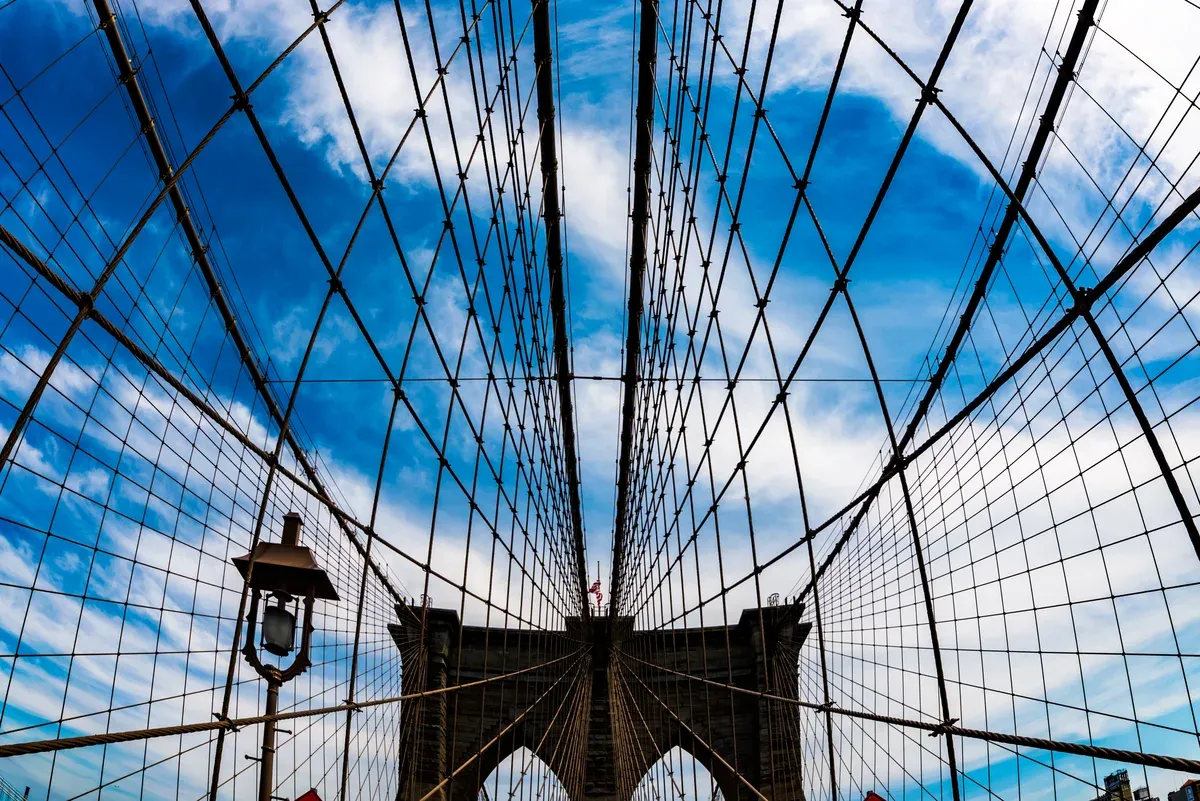
The suspension cables spreading from a tower of the Brooklyn Bridge. Photo: Meihe Chen, CC BY-SA 4.0, via Wikimedia Commons
Quick answer Brooklyn Bridge tour in brief
A guided Brooklyn Bridge tour costs $49 (Inside Out Tours, 2 hours 30 minutes) on the site's bookable list. Walking alone is free, and tolls were abolished in 1911. The bridge is 5,989 feet long measured from the Centre Street curb (NYC DOT lists 6,016 feet with approaches) and its main span is 1,595.5 feet. Ramps and staircases connect the walkway to DUMBO.
Key takeaways
- The guided option that crosses the bridge end to end is the Brooklyn Bridge and DUMBO tour, a 2 hour 30 minute walk from the Tweed Courthouse.
- Skip the guide with the walking it alone section, which covers both entrances and the pedestrian promenade.
- Prefer to see the bridge from the water? The AIANY Architecture Cruise sails past it with architects aboard.
- A combined bridge-and-neighborhood option is covered on the Brooklyn Bridge and DUMBO tour page.
Guided Brooklyn Bridge Walks Compared
Several listings in the catalog put the Brooklyn Bridge on the route. Two walk on it, one sails under it. Prices and durations come from each listing.
The Tours That Include the Bridge
The table lists every catalog tour whose route names the Brooklyn Bridge. Two are walking tours, one is an architect-narrated yacht cruise. Note what the walk-through options do not include: no listing states entry to any building, and none is led by an architect.
The cruise is the only one led by architects, members of the AIA New York Chapter, and it views the bridge from the East River rather than walking it. All prices are per person exactly as listed.
| Tour | Price | Length | Start | Ends |
|---|---|---|---|---|
| Brooklyn Bridge & DUMBO Neighborhood Tour | $49 | 2 hours 30 minutes | Tweed Courthouse, between Broadway and Centre Streets | DUMBO and the Brooklyn waterfront |
| SoHo, Little Italy and Chinatown Guided Tour | $28 | 2 hours | Warren Street and Broadway, at City Hall Subway Station | Prince Street |
| Manhattan Official NYC Architecture Cruise | $86 | 2 hours to 2 hours 45 minutes | Chelsea Piers, Pier 62 | Chelsea Piers |
Guided or On Your Own
The strongest match for the keyword is the Brooklyn Bridge & DUMBO Neighborhood Tour at $49 per person, rated 4.9 from 907 reviews. It meets at the Tweed Courthouse and walks over the bridge into DUMBO with the construction story on the way. Groups run up to 30, and a private option takes 1 to 10. What it does not include: no building entry is stated, and gratuities are extra.
The $28 SoHo, Little Italy and Chinatown Guided Tour passes the bridge as one stop of a wider downtown walk, so it suits you only if you want Chinatown, Little Italy and SoHo as well. It is rated 4.8 from 813 reviews and lasts 2 hours.
The $86 Manhattan Official NYC Architecture Cruise is the only listing led by architects. It circles Manhattan in 2 to 2 hours 45 minutes and includes one drink, with the Brooklyn Bridge among the sights. Choose the guided walk for the Roebling story at street level, the cruise for the skyline, or walk alone for nothing, which is what about 30,000 pedestrians a day were doing by NYC DOT's count.
- Walking tour over the bridge: $49, 2 hours 30 minutes, up to 30 people
- Downtown walk that passes the bridge: $28, 2 hours
- Architect-led cruise past the bridge: $86, 2 to 2 hours 45 minutes
- Walking alone: free, tolls were abolished in 1911
Walking It Alone
The walkway is free and open on both ends. Here is where to get on, what you will walk on, and what to look up at.
The Manhattan Entrance
On the Manhattan side the pedestrian walkway is reached from crosswalks where the bridge meets Centre Street, or by a staircase to Park Row. The bridge's total length is 5,989 feet measured from the Centre Street curb, though NYC DOT lists 6,016 feet including the approaches. Once on the ramp you climb toward the first of the two masonry towers.
The towers stand 276 feet 6 inches above high water according to the National Park Service landmark nomination, which also measures them 140 by 59 feet at the water line, while Wikipedia gives 278 feet, so sources differ slightly. Their pointed arch openings are 33 feet 9 inches wide and rise 117 feet above the roadway. The Brooklyn tower was finished in June 1875 and the New York tower thirteen months later.
The Brooklyn Entrance
On the Brooklyn side pedestrians enter from the Adams Street median at Tillary Street, or by a staircase near Prospect Street between Cadman Plaza East and West. Ramps and staircases also connect the walkway down into DUMBO, so you can drop off the bridge directly into the neighborhood rather than continuing to Tillary Street. At the bottom, Brooklyn Bridge Park offers 85 free acres open daily from 6 AM to 1 AM, and the Brooklyn Heights Promenade, 1,826 feet long, runs from Remsen Street to Orange Street with views of Lower Manhattan.
For what to do once you arrive, the district guide lives on the DUMBO Brooklyn page.
The Promenade and the Bike Lane
The elevated promenade runs between the two roadways, 18 feet above them, and is generally 10 to 17 feet wide. Since September 14, 2021 a two-way protected bike path has occupied the former leftmost Manhattan-bound vehicle lane, which leaves the promenade for pedestrians only, so walkers no longer share a painted center line with cyclists. That line, painted in 1971, had made the promenade one of the city's first dedicated bike lanes.
Below, the bridge now carries three Brooklyn-bound and two Manhattan-bound vehicle lanes, and only passenger vehicles are allowed. NYC DOT counted over 116,000 vehicles, 30,000 pedestrians and 3,000 cyclists crossing each day. Walking time across is not stated by NYC DOT, so any duration you read elsewhere is an estimate.
Street vendors have been banned from the bridge since January 2024, the month its new LED lights were first lit.
Cables, Elephants and the Roeblings
Look up at the main cables as you cross. Each is 15.75 inches in diameter and made of 19 strands of 278 wires each, the first use of wire bundling in a suspension bridge, and each cable contains 5,282 steel wires in total. John A. Roebling designed the bridge, and his son Washington Roebling became chief engineer after John's death in 1869.
Emily Warren Roebling supervised much of the construction and was the first to cross. The bridge opened May 24, 1883 after construction from 1870, cost $15.5 million, and killed about 27 workers. A million people paid to cross in the first six months.
To calm doubters, P.T. Barnum led Jumbo and a parade of 21 elephants over the span on May 17, 1884. It became a National Historic Landmark in 1964 and an NYC landmark in 1967.
Walking the Brooklyn Bridge in NYC
The walk across, the entrances and what to expect on the promenade. Third-party video by Santorini Dave. This site did not shoot it and has no relationship with the creator.
The Roeblings' Bridge
The Brooklyn Bridge is as much an engineering story as a walk, and the numbers explain why it has held up since 1883.
John, Washington and Emily Roebling
John A. Roebling designed the bridge and died in 1869, before construction could finish what he started in 1870. His son Washington Roebling took over as chief engineer. When Washington fell ill, Emily Warren Roebling supervised much of the remaining construction, and she was the first person to cross the finished bridge. The project cost $15.5 million and about 27 workers died building it. The bridge opened on May 24, 1883, and a million people paid to cross in its first six months. In 1884 it carried 8.5 million people. A guided Brooklyn Bridge and DUMBO walk tells this story on the way across.
If you want the full tour-by-tour breakdown of the guided crossings, the Brooklyn Bridge and DUMBO tour guide covers it in depth. For the whole range of New York architecture tours on this site, start at the homepage.
The Towers
The two towers are Gothic Revival masonry in limestone, granite and Rosendale cement, each measuring 140 by 59 feet at the water line. Their pointed arch openings are 33 feet 9 inches wide and rise 117 feet above the roadway. The Brooklyn tower was finished in June 1875 and the New York tower thirteen months later.
Sources disagree on the height, so both figures are given here: the National Park Service landmark nomination says 276 feet 6 inches above high water, while Wikipedia says 278 feet.
| Feature | Figure | Source |
|---|---|---|
| Tower height above high water | 276 ft 6 in or 278 ft (sources differ) | NPS nomination / Wikipedia |
| Arch openings | 33 ft 9 in wide, 117 ft above roadway | NPS nomination |
| Main span | 1,595.5 ft | Wikipedia |
| Side spans | 930 ft each | Wikipedia |
| Total length | 5,989 ft or 6,016 ft with approaches (sources differ) | Wikipedia / NYC DOT |
| Clearance at center | 135 ft (NYC DOT) or 127 ft above mean high water (Wikipedia) | NYC DOT / Wikipedia |
The Cables
The bridge is a hybrid cable-stayed and suspension design, and its cables were revolutionary. Each main cable is 15.75 inches in diameter and made of 19 strands of 278 wires each, the first use of wire bundling in a suspension bridge. Suspenders hold the deck: counts range from 1,088 galvanized wire cables to other tallies of 1,096 or 1,520, so the exact figure is not settled.
Since the 2000s the main cables have carried 24-watt LED necklace lights. NYC DOT also records that the original paint scheme was Brooklyn Bridge Tan and Silver, though other accounts say Rawlins Red throughout.
Jumbo and the Doubters
On May 17, 1884, P.T. Barnum marched 21 elephants across the promenade, led by Jumbo. The parade helped ease doubts about the bridge's stability and promoted Barnum's circus. The cable cars of the New York and Brooklyn Bridge Railway had begun running on September 25, 1883.
About 4.5 million pedestrians a year were crossing for free by 1892, and tolls were abolished in 1911. The bridge became a National Historic Landmark in 1964 and an NYC landmark in 1967. If you would rather see it from the water, the AIANY architecture cruise circles Manhattan and passes the Brooklyn Bridge with architects from AIA New York as hosts.
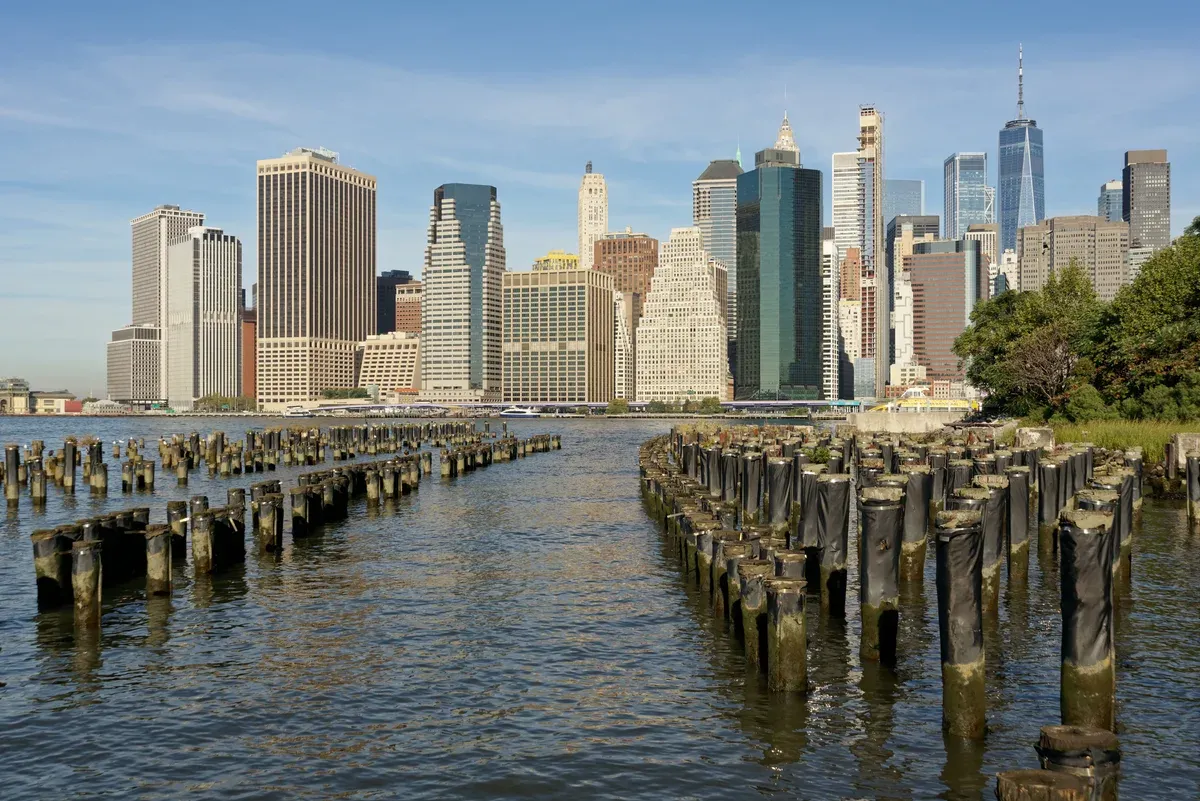
View of Manhattan from Brooklyn Bridge Park. Photo: Jakub Hałun, CC BY 4.0, via Wikimedia Commons
What to Do at the Brooklyn End
Both sides of the Brooklyn Bridge exit into neighborhoods that reward an extra hour or two, and the walkways connect directly to DUMBO.
DUMBO, at the Foot of the Ramps
Ramps and staircases run from the Brooklyn Bridge walkway down into DUMBO, the district between the two bridges. For the full neighborhood guide, see DUMBO Brooklyn. For a guided version, the Brooklyn Bridge and DUMBO tour ends in the neighborhood.
Brooklyn Bridge Park and the Waterfront
Brooklyn Bridge Park covers 85 acres along 1.3 miles of waterfront and is free, open daily from 6 AM to 1 AM. It is divided into eleven sections including Piers 1 to 6, Fulton Ferry Landing and Empire Fulton Ferry. Jane's Carousel, a 48-horse carousel built in 1922, sits in a pavilion designed by Jean Nouvel at 65 Water Street.
Empire Stores is a seven-building, 330,000-square-foot former coffee warehouse completed in 1869, now home to Time Out Market. Fulton Ferry Landing marks Brooklyn's first ferry landing from 1642 and hosts the Bargemusic concert venue. The park was designed by Michael Van Valkenburgh Associates, with its first section opening in March 2010 and completion in December 2021.
Any New York City architecture tour that crosses the bridge can be paired with this waterfront on foot.
Brooklyn Heights
From the Brooklyn end, walk south into Brooklyn Heights, whose historic district was designated on November 23, 1965 as the city's first historic district. It holds over 600 pre-Civil War houses in Federal, Greek Revival and Italianate styles, and 24 Middagh Street from 1824 is the oldest surviving house. Plymouth Church at 57 Orange Street, built 1849 to 1850, was led by the abolitionist Henry Ward Beecher.
The Brooklyn Heights Promenade runs 1,826 feet from Remsen Street to Orange Street, cantilevered over the BQE, with views of Lower Manhattan and New York Harbor. Its southern half opened October 7, 1950 and the northern half on December 7, 1951. To head back, the NYC Ferry stop at Fulton Ferry is on the East River route, or take the subway from York Street on the F line or High Street on the A and C lines.
Sources: NYC DOT, NPS landmark nomination, Brooklyn Bridge Park
Do and Don't on a Brooklyn Bridge Tour
Five things worth doing and four worth avoiding, each drawn from how the bridge actually works.
Do
- Do walk toward Brooklyn from the Manhattan side, because the skyline stays in front of you the whole way and the Brooklyn exits put you in DUMBO and Brooklyn Heights for the return.
- Do keep to the promenade and leave the center line alone, because the painted center line dates from 1971 and marks one of the city's first dedicated bike lanes, while a two-way protected bike path completed September 14, 2021 took cyclists off the promenade entirely, leaving it for pedestrians only.
- Do go at a time that suits crowds, because NYC DOT counted over 30,000 pedestrians and 3,000 cyclists crossing daily as of 2018, and NYC DOT announced in 2016 a plan to double the promenade's width because it is one of the city's most popular picture spots.
- Do book a guided walk if you want the story told properly, because the Brooklyn Bridge and DUMBO tour covers the Roeblings' construction history at $49 per person for 2 hours 30 minutes with free cancellation 24 hours ahead.
- Do extend into Brooklyn Bridge Park at the end, because the 85-acre park is free, open daily 6 AM to 1 AM, and its ramps and staircases connect straight to the bridge walkway.
Don't
- Don't bring a bicycle onto the promenade, because the promenade is pedestrians only since the protected bike path opened on September 14, 2021, and cyclists have their own path on the roadway level.
- Don't expect to buy anything on the bridge, because all street vendors were banned from the bridge in January 2024, the same month its new LED lights were first lit.
- Don't assume walking time from the total length, because the published figures of 5,989 or 6,016 feet include approaches, and no official source states the walkable time between entrances.
- Don't ignore which vehicle lanes remain, because only passenger vehicles are allowed on the bridge, which now has three Brooklyn-bound and two Manhattan-bound lanes after the bike path conversion.
Brooklyn Bridge Tour Questions
Is a Brooklyn Bridge walking tour worth it?
A guided crossing earns its price if you want the story of the Roeblings, the $15.5 million build and the 1884 elephant parade told as you walk. The Brooklyn Bridge and DUMBO neighborhood tour costs $49 per person, lasts 2 hours 30 minutes and is rated 4.9 from 907 reviews. Walking it yourself is free.
Where should I start walking the Brooklyn Bridge?
On the Manhattan side, the walkway is reached from crosswalks where the bridge meets Centre Street, or by a staircase to Park Row. On the Brooklyn side, enter from the Adams Street median at Tillary Street or by a staircase near Prospect Street between Cadman Plaza East and West. See the full walk guide for both ends.
Can I reach DUMBO from the Brooklyn Bridge walkway?
Yes. Ramps and staircases connect the walkway to DUMBO, which lies between the Manhattan and Brooklyn Bridges. The DUMBO Brooklyn guide covers the neighborhood in full.
How long is the walk across the Brooklyn Bridge?
The total length is 5,989 feet measured from the Centre Street curb, or 6,016 feet with approaches per NYC DOT. An official walking time is not stated in any source, so plan your own pace. A guided tour budgets 2 hours 30 minutes for the crossing plus DUMBO.
Is there a tour that covers both the Brooklyn Bridge and DUMBO?
Yes. The Brooklyn Bridge and DUMBO neighborhood tour runs from the Tweed Courthouse over the bridge into DUMBO, at $49 per person for 2 hours 30 minutes with a local guide. More options appear on the New York architecture tour homepage.
Do any other tours name the Brooklyn Bridge?
Yes, two. The SoHo, Little Italy and Chinatown tour lists the Brooklyn Bridge among its stops but does not say it crosses the span, and the architect-narrated cruise sails past it from the water instead.