 New York Architecture Tour
DUMBO Brooklyn: An Architecture Guide to the Warehouse District
DUMBO Brooklyn is the strip of 19th century factory buildings between the Manhattan and Brooklyn Bridges on the Brooklyn waterfront. This guide covers the name, the warehouses of Robert Gair, the historic district of 95 buildings, the Washington Street view, Jane's Carousel and Brooklyn Bridge Park. It is part of the coverage of New York architecture tours by district, and it ends with the walk that brings you here from Manhattan. The bookable tours are compared on New York architecture tours.
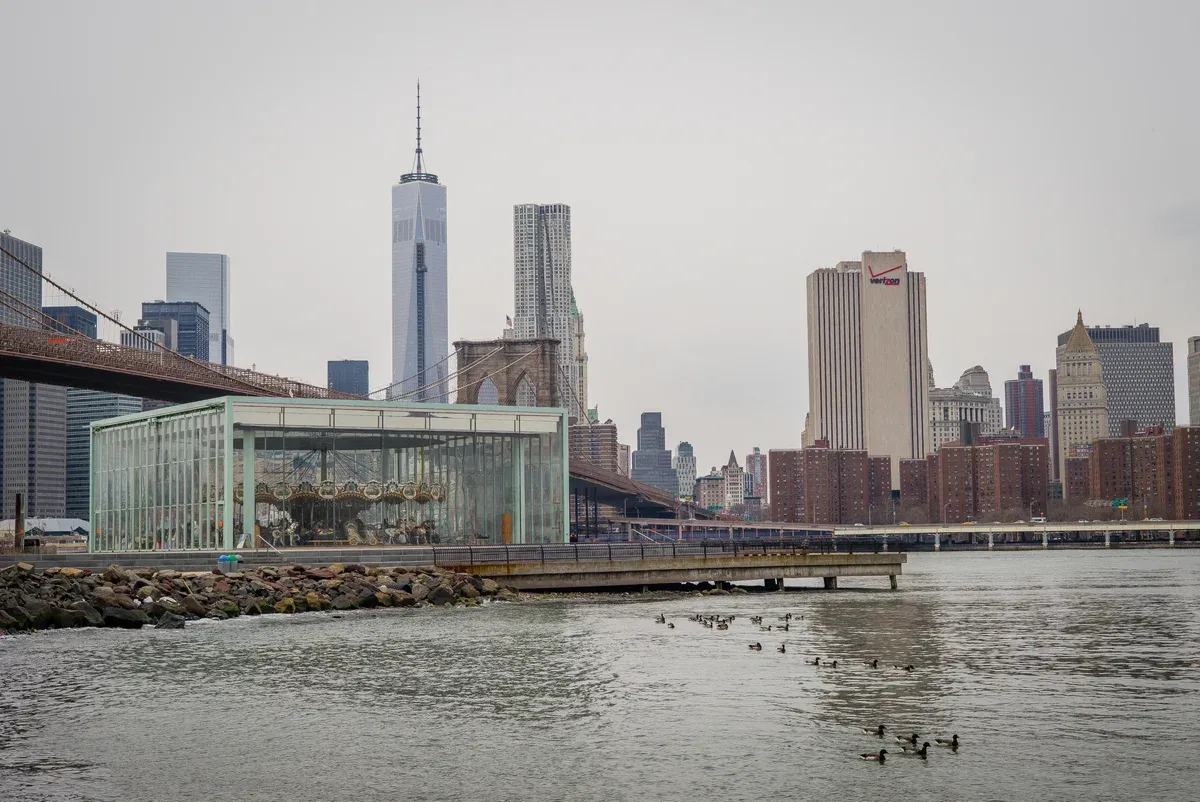
Jane's Carousel against the backdrop of Lower Manhattan. Photo: Cubie King, CC BY-SA 3.0, via Wikimedia Commons
Quick answer DUMBO at a glance
DUMBO Brooklyn is a former factory district of 95 historic warehouse buildings between the Manhattan and Brooklyn Bridges, designated a historic district in 2007. Entry to the neighborhood and to Brooklyn Bridge Park is free, and the park is open daily from 6 AM to 1 AM. A guided walk covering the bridge and the district costs $49 per person.
Key takeaways
- Book a guided option such as the Brooklyn Bridge and DUMBO neighborhood tour, $49 per person, which ends in the district.
- Prefer to walk it yourself? Start with the Brooklyn Bridge tour page, then follow the ramp down into DUMBO.
- Get the figures first in the DUMBO in Figures section below.
- Head straight for the views: Washington Street, the waterfront and Jane's Carousel.
DUMBO in Figures
The numbers that define the district, drawn from city records, the park's own site and standard references.
Key Facts and Dates
The table below gathers the dates and figures used throughout this guide. They come from the park's official site, New York City designation records and standard reference entries on the neighborhood and its buildings. Together they explain why DUMBO looks the way it does: a working port turned landmark district with a new park along 1.3 miles of waterfront.
| Place | Year | Detail |
|---|---|---|
| Fulton Ferry Landing | 1642 | Brooklyn's first ferry landing opened |
| Empire Stores | 1869 | Seven warehouse buildings, 330,000 square feet, additions in 1885 |
| Robert Gair building, Washington Street | 1879 | The cardboard box was invented here, now home to Etsy |
| DUMBO Historic District | 2007 | New York City's 90th historic district, designated December 18 |
| Brooklyn Bridge Park | 2010 | First section opened in March, 85 acres, complete in December 2021 |
How a Warehouse District Became DUMBO
The name came last. The area was historically called Gairville, after Robert Gair, a paper-box maker born in Edinburgh in 1839. In 1879 a creasing ruler in his building on Washington Street shifted and cut a bag, and the accident produced the folding paperboard carton. His factories grew along the waterfront, and in the 1890s the western part of the district was known as Fulton Landing. Before the 1970s the factories here made machinery, paper boxes, spices and Brillo soap pads.
The acronym DUMBO, Down Under the Manhattan Bridge Overpass, was coined in 1978 by artists who had moved into the lofts. They chose an unattractive name on purpose, believing it would deter developers. It did not hold them off forever, but the factories survived long enough to be protected. The National Register listed the DUMBO Historic District in 2000 with 95 contributing buildings, and the city designated its own historic district on December 18, 2007, the 90th in the five boroughs. The district includes the earliest large-scale reinforced concrete factory buildings in America.
Look down as you walk. The Jay Street Connecting Railroad ran through the waterfront from about 1904 to 1957, and its tracks are still visible set into the streets. The Belgian block streets themselves completed a $108 million restoration.
The simplest way to take all of this in is on foot with a guide. The Brooklyn Bridge and DUMBO neighborhood tour runs 2 hours 30 minutes for $49 per person, starting at the Tweed Courthouse in Manhattan and finishing in the district. For more walking options across the city, see the comparison of New York architecture tours.
The Views: Washington Street and the Waterfront
Two very different views define DUMBO: a framed shot of a bridge, and the open harbor.
The Washington Street View of the Manhattan Bridge
The view from Washington Street is the neighborhood's best-known photo spot. You stand in the middle of a Belgian block street and the Manhattan Bridge frames itself between the brick warehouses on either side. The bridge behind the camera opened on December 31, 1909, designed by Leon Moisseiff with a main span of 1,480 feet. Its Manhattan-side arch and colonnade, by Carrere and Hastings, were completed in 1915.
The entry plaza of Main Street Park sits at Washington Street. For the story of the other bridge, the one you most likely crossed to get here, see the page on the Brooklyn Bridge tour, which covers the walk itself in detail.
Main Street Park and the Water's Edge
Main Street Park covers 4.8 acres under the Manhattan Bridge and opened in December 2002. It has a playground, a dog run, a rock-climbing area and beach portions at the water's edge. The Cliffs opened DUMBO Boulders here in April 2016, then the largest bouldering facility in North America. Next door, Empire Fulton Ferry adds 4.5 acres with a lawn and a promenade facing the East River, and was a state park until 2010.
All of this is part of Brooklyn Bridge Park, 85 acres designed by Michael Van Valkenburgh Associates, running 1.3 miles from Atlantic Avenue to Jay Street. Entry is free and the park is open seven days a week from 6 AM to 1 AM. Ramps and staircases connect both bridge walkways to the neighborhood, so you can walk down from the Brooklyn Bridge and land directly in the park.
Jane's Carousel and Empire Stores
Jane's Carousel sits on the Empire Fulton Ferry waterfront in a pavilion designed by Jean Nouvel. The carousel itself is far older: 48 horses built in 1922 by the Philadelphia Toboggan Company, carved by John Zalar and Frank Carretta. Jane and David Walentas bought it at auction in 1984 for $385,000 and restored it over 22 years. It reopened in the park at 65 Water Street on September 16, 2011. Its current ticket price and hours are not stated here.
Nearby stands Empire Stores, a seven-building warehouse complex of 330,000 square feet completed in 1869 with additions in 1885. It stored coffee, sugar and molasses. The redevelopment by Midtown Equities with Studio V Architecture and S9 Architecture kept the schist walls, the iron hoisting wheels and the coffee chutes. Time Out Market opened inside in May 2019, and the Brooklyn Historical Society runs a 3,200-square-foot museum there.
At Fulton Ferry Landing you reach Brooklyn's first ferry landing, opened in 1642, now a viewing point for the Manhattan skyline and home to the Bargemusic concert venue. An NYC Ferry stop at Fulton Ferry on the East River route serves the same pier. Gleason's Gym, the oldest boxing gym in New York, where Muhammad Ali and Mike Tyson trained, has been at 130 Water Street since 2016. On Sundays from April to October, the Brooklyn Flea fills the DUMBO Archway under the Manhattan Bridge.
DUMBO Brooklyn Walking Tour
A walk through the streets and waterfront of DUMBO. Third-party video by Tom Delgado. This site did not shoot it and has no relationship with the creator.
Getting There and Back
DUMBO sits between two bridges with two subway lines underneath it, so the neighborhood is easy to reach and just as easy to leave.
Two Subway Stops Serve DUMBO
The F train stops at York Street on the IND Sixth Avenue Line, and the A and C trains stop at High Street on the IND Eighth Avenue Line. Both stations serve the district, which takes its name from the Manhattan Bridge overhead: Down Under the Manhattan Bridge Overpass, a name coined in 1978.
For more walking routes across the East River, see the Brooklyn Bridge tour guide, which covers the bridge itself and the approaches on both sides. And if you want to compare this district with Manhattan's buildings, the New York architecture tours hub lists every district and style in one place.
| Stop | Lines | Line name |
|---|---|---|
| York Street | F | IND Sixth Avenue Line |
| High Street | A and C | IND Eighth Avenue Line |
Arriving on Foot, by Ferry or by Ramp
Ramps and staircases connect both the Brooklyn Bridge and the Manhattan Bridge walkways directly into DUMBO, so the neighborhood is the natural landing point for anyone crossing on foot. On the Brooklyn side of the Brooklyn Bridge, pedestrians enter from the Adams Street median at Tillary Street or by a staircase near Prospect Street between Cadman Plaza East and West. The DUMBO Archway under the Manhattan Bridge hosts the Brooklyn Flea every Sunday from April to October.
There is also a water route. DUMBO has an NYC Ferry stop at Fulton Ferry on the East River route, which drops you at a landing that has served Brooklyn since 1642, when the first ferry opened there.
What to Expect on the Ground
Wear shoes you do not mind scuffing. DUMBO's Belgian block streets completed a $108 million restoration. The tracks of the Jay Street Connecting Railroad, which ran along the waterfront from about 1904 to 1957, are still visible set into the streets, and spotting them is half the pleasure of walking here.
Brooklyn Bridge Park runs 1.3 miles along the water and is free to enter, open daily from 6 AM to 1 AM, so you can end any arrival with a skyline walk.
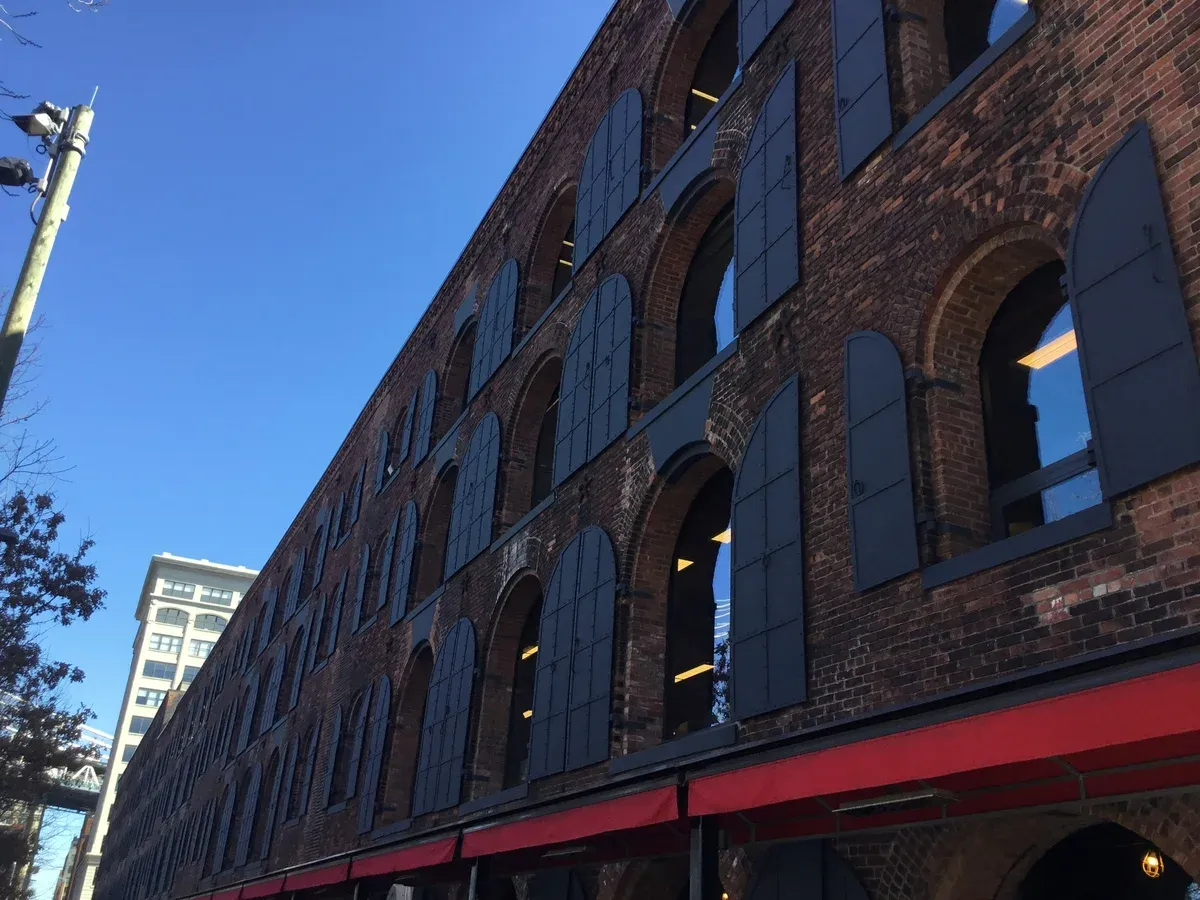
Empire Stores in Dumbo, Brooklyn. Photo: Kidfly182, CC BY-SA 4.0, via Wikimedia Commons
The Walk That Ends in DUMBO
One guided tour in the catalog does exactly what this page describes: it starts in Manhattan, crosses the Brooklyn Bridge and finishes in the streets of DUMBO.
The Brooklyn Bridge and DUMBO Tour, What You Get
The pick for this district is the Brooklyn Bridge & DUMBO Neighborhood Tour, listed at $49 per person on the booking platform. It runs 2 hours 30 minutes, is led by a local guide from Inside Out Tours LLC, and groups run up to 30, with a private option for 1 to 10 people. It starts in front of the Tweed Courthouse between Broadway and Centre Streets, crosses the Brooklyn Bridge with the construction story told along the way, and ends in DUMBO and the Brooklyn waterfront. The listing names Tweed Courthouse, the Brooklyn Bridge, DUMBO and the Brooklyn waterfront as the landmarks passed. Gratuities are not included, and free cancellation is available 24 hours ahead.
It is honest to note what the listing does not claim. It does not say the tour enters any building, so you should not expect access to Empire Stores' interiors or the carousel on a guided ticket. If the bridge crossing itself is the priority rather than the district, the dedicated Brooklyn Bridge tour guide covers the walkway, its history and how to do it unguided. For the wider catalog, the New York architecture tours homepage compares tours by district and by style.
| Detail | Listing says |
|---|---|
| Price | $49 per person |
| Duration | 2 hours 30 minutes |
| Operator | Inside Out Tours LLC |
| Platform | the booking platform |
| Group size | Up to 30, private option 1-10 |
| Meeting point | In front of the Tweed Courthouse, between Broadway and Centre Streets |
| Rating | 4.9 from 907 reviews |
Why a Guided Crossing Works for DUMBO
The bridge is 5,989 feet long measured from the Centre Street curb, or 6,016 feet with approaches per NYC DOT, with a main span of 1,595.5 feet, and its story is dense enough that a guide earns the $49. John A. Roebling designed it and his son Washington Roebling took over as chief engineer after his father's death in 1869, while Emily Warren Roebling supervised much of the construction and was the first to cross. The bridge cost $15.5 million and about 27 people died building it. Arriving in DUMBO with that story behind you changes how the district reads.
If you prefer to end your day on the water instead of on your feet, the Manhattan architecture cruise with AIA New York architects at $86 per person circles the island past the Brooklyn Bridge, though it does not stop in DUMBO itself.
DUMBO Tips From the Facts
Do
- Do start at Brooklyn Bridge Park because entry is free and the 85-acre park is open every day from 6 AM to 1 AM, so it frames any visit at no cost.
- Do walk Washington Street for the Manhattan Bridge view, because it is the photo spot the neighborhood is known for and sits at the entry plaza of Main Street Park.
- Do go under the DUMBO Archway on a Sunday between April and October, when the Brooklyn Flea fills the space beneath the Manhattan Bridge.
- Do look down at the streets, because the Belgian blocks finished a $108 million restoration and the Jay Street Connecting Railroad tracks from about 1904 to 1957 are still set in them.
- Do take the stairs or ramp from the bridge walkway down into DUMBO, because ramps and stairs connect both the Brooklyn Bridge and the Manhattan Bridge walkways to the neighborhood.
Don't
- Don't assume a walking tour includes building entry, because the Brooklyn Bridge & DUMBO Neighborhood Tour listing names only outdoor stops and does not state interior access.
- Don't rely on the F alone if you are coming from an A or C corridor, because High Street on the A and C is the neighborhood's other station and may save a transfer.
- Don't plan on driving in, because the Belgian block streets and the parks along 1.3 miles of waterfront are best seen on foot.
- Don't skip Empire Stores because it looks like just a warehouse, because the seven-building, 330,000-square-foot complex completed in 1869 kept its schist walls, iron hoisting wheels and coffee chutes in the redevelopment.
DUMBO Brooklyn Questions
What subway station do I take for DUMBO?
Two stations serve the district: York Street on the F line and High Street on the A and C lines.
How did DUMBO get its name?
DUMBO stands for Down Under the Manhattan Bridge Overpass, a name coined in 1978 by artists who moved into the lofts and hoped an unattractive name would deter developers. It worked slowly, since the historic district was not designated until December 18, 2007.
Was DUMBO always called DUMBO?
No. The area was historically called Gairville or Gairsville after paper-box maker Robert Gair, and in the 1890s its western part was known as Fulton Landing. Gair invented the folding paperboard carton in 1879 in his building on Washington Street, which now houses Etsy. See the DUMBO Brooklyn guide for the full industrial story.
What are the best things to do in DUMBO for people interested in architecture?
Walk Washington Street for the Manhattan Bridge view, circle Empire Stores, a seven-building warehouse of 330,000 square feet completed in 1869, see Jane's Carousel in its Jean Nouvel pavilion, and look for the old railroad tracks in the streets. A guided option that ends in the district is the Brooklyn Bridge & DUMBO Neighborhood Tour at $49 per person.
Can I walk from the Brooklyn Bridge into DUMBO?
Yes. Ramps and staircases connect the bridge walkway to the neighborhood, and on the Brooklyn side pedestrians can enter the walkway from the Adams Street median at Tillary Street. The Brooklyn Bridge tour guide details the walkway and its entrances.
Is there a ferry to DUMBO?
Yes, NYC Ferry stops at Fulton Ferry on the East River route. The landing marks Brooklyn's first ferry landing, opened in 1642, and now offers Manhattan skyline views and the Bargemusic concert venue next to Brooklyn Bridge Park.